

Margin Notes: Magnifica Humanitas, by Pope Leo XIV
Notes on justice, subsidiarity, and the spiritual responsibility of AI developers


Welcome to From the Ethics Desk! Share this post, support this publication, or learn more about me, Adam Hollowell. Thanks for reading. I’m glad you’re here!
In my Substack Notes I post carousels of my favorite lines from books, along with the thoughts, connections, and ideas I scribbled in the margins. Today I’m commenting on Pope Leo XIV’s recent papal encyclical, Magnifica Humanitas. Here’s a quick description of the (mini) book, 6 quotes I underlined, and my comments on each.
Thanks for reading! -Adam
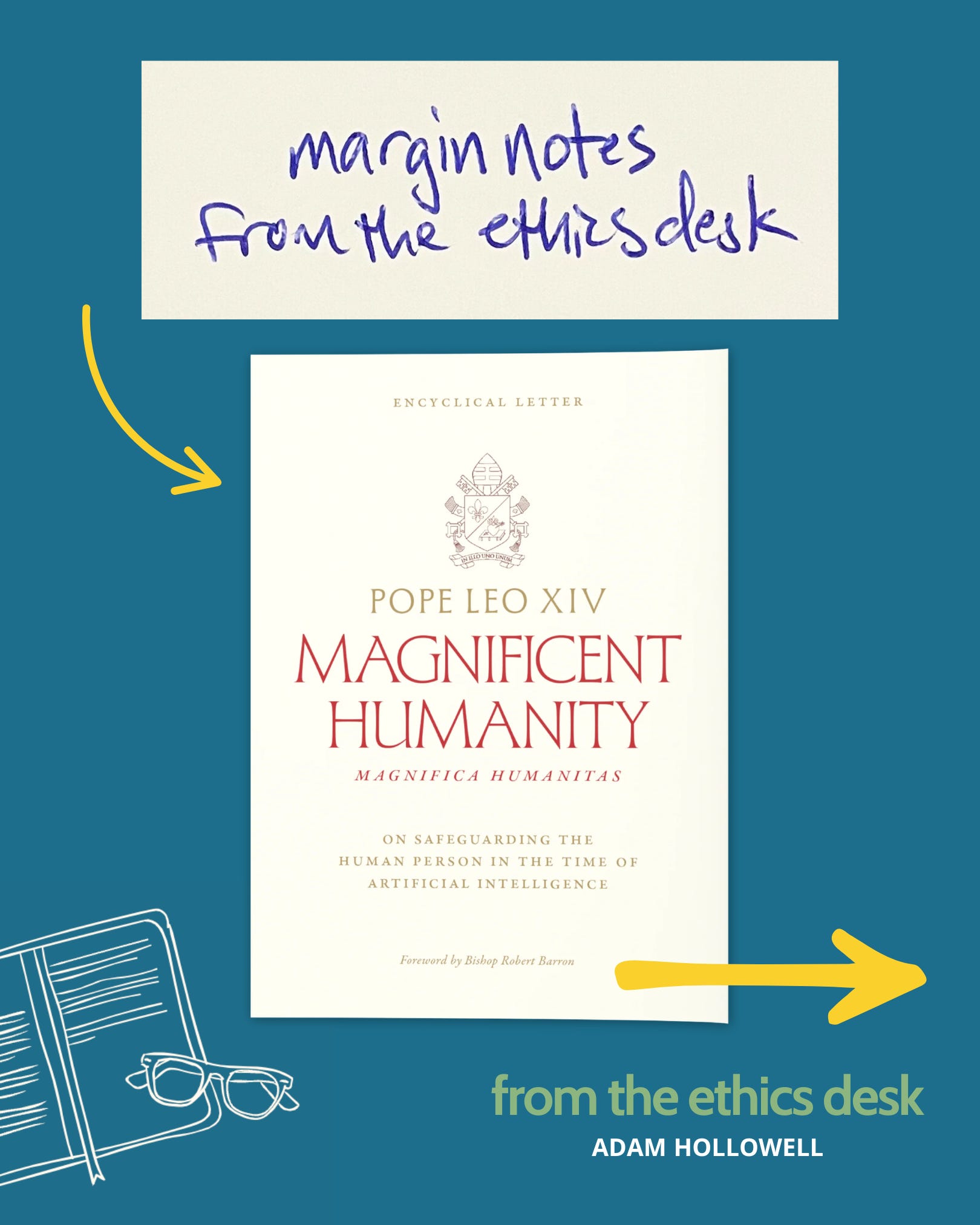
Magnifica Humanitas by Pope Leo XIV
An encyclical is teaching from the Catholic Church in its most formal, widely-amplified voice. The Church elected Leo XIV just last year, and for his very first encyclical he chose to write about artificial intelligence. It’s called Magnifica Humanitas (Magnificent Humanity, in English), and it parallels Pope Leo XIII’s Rerum Novarum encyclical from 1891, which launched modern Catholic social teaching and argued for the importance of an economy that upholds human dignity. Leo XIV takes both his name and the mantle of Catholic social teaching from Leo XIII, focusing in Magnifica Humanitas on the need for dignity and justice in a world of rapidly developing AI.
Each encyclical is a letter from the pope to the faithful and anyone else who’s willing to listen. I was among the willing, this time, and here’s what I heard. (Or, what I wrote in the margins as I read.)
1. Too harsh
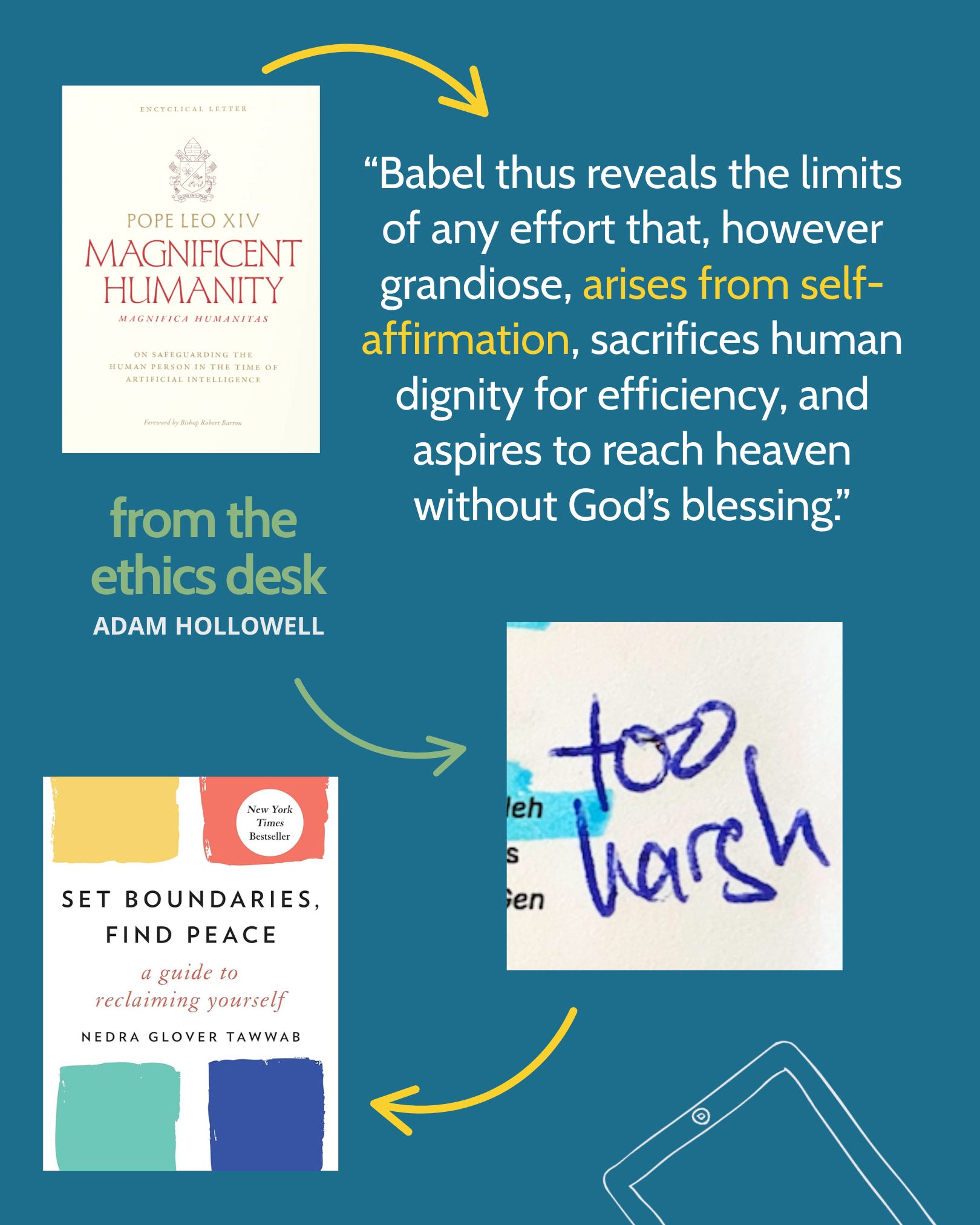
“Babel thus reveals the limits of any effort that, however grandiose, arises from self-affirmation, sacrifices human dignity for efficiency, and aspires to reach heaven without God’s blessing.” — Pope Leo XIV, Magnifica Humanitas
I love most of this line — the priority of human dignity over efficiency, the destructiveness of grandiosity, and the linking heaven and God’s blessing to humility, collectivity, and sacrifice. Still, I bumped on “arises from self-affirmation.” Self-aggrandizement is a problem, as are self-congratulations and an old-fashioned god complex. But self-affirmation is a part of how we muster the courage, dignity, and resilience to reach for heaven on earth. Self-love and other-love should be companions rather than rivals.
This is the same thread I pulled two weeks ago, when I wrote about Nedra Glover Tawwab’s work on boundaries and the ethics of love.
2. Not the post-humanism I’ve read
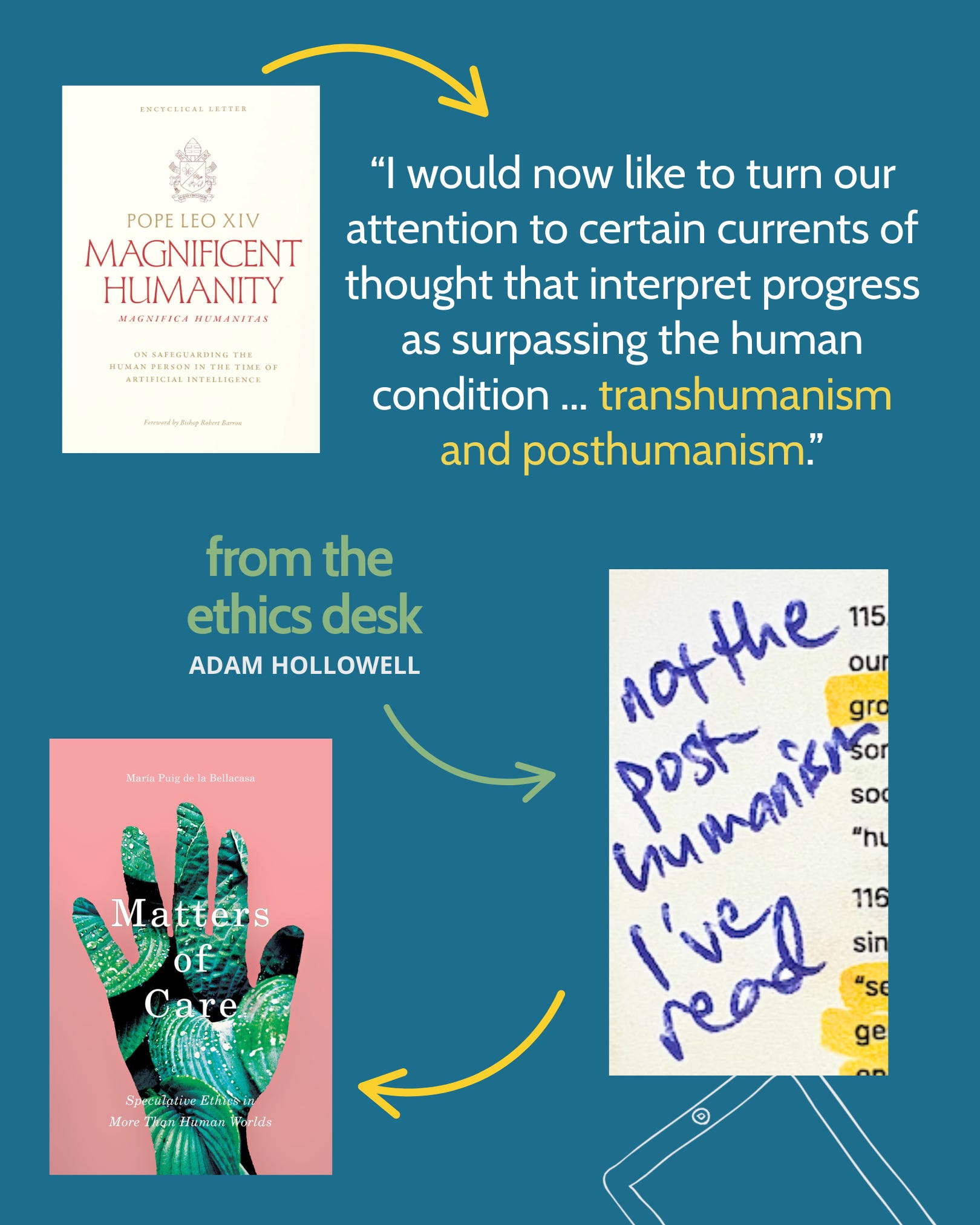
“I would now like to turn our attention to certain currents of thought that interpret progress as surpassing the human condition, and which are often grouped together under the labels of transhumanism and posthumanism.” — Pope Leo XIV, Magnifica Humanitas
“If the human being is treated as something to be perfected or surpassed, it becomes easier to accept that some lives are less useful, less desirable, or less worthy.” — Pope Leo XIV, Magnifica Humanitas
The pope is right that treating the human as something to be surpassed makes it dangerously easy to sort lives into the useful and the disposable. (See Peter Thiel’s uncomfortably long pause when asked if the human race should survive.) And I don’t know much about transhumanism. But the posthumanism I’ve read — María Puig de la Bellacasa’s Matters of Care, Alexis Shotwell’s Against Purity — aren’t about leaving the human behind. They’re confrontations with the damage that anthropocentrism has done to the environment, other species, and to humans. Their ethical visions are deeply rooted in care, collective sustainability, and restoration of harm. (Shotwell’s forthcoming book is called Liberation is Other People.)
I wrote about on this theme last year in Not Higher, Not Better — Just Woven In.

3. PREACH!
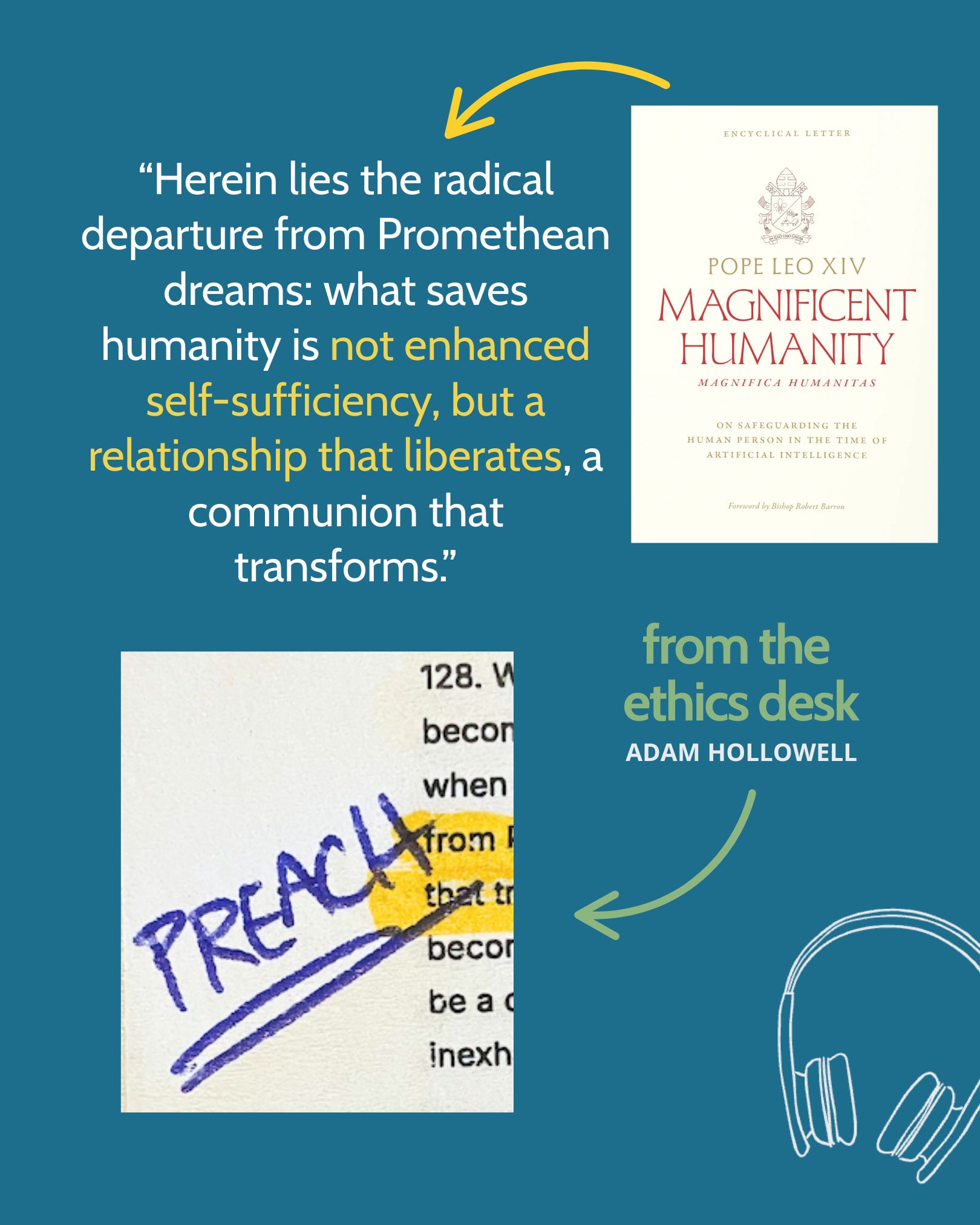
“Herein lies the radical departure from Promethean dreams: what saves humanity is not enhanced self-sufficiency, but a relationship that liberates, a communion that transforms. In this light, a technology that merely classifies and optimizes what already exists can, however unintentionally, become an obstacle to change and growth. For an algorithm, an error is a flaw to be corrected; for a person, however, an error can be a catalyst for profound change. A person’s future is not calculable, but depends on one’s freedom — elevated by the inexhaustible grace of God — and on the relationships cultivated.” — Pope Leo XIV, Magnifica Humanitas
There’s so much of what we need here: making peace with our imperfections, pushing back against the forces of efficiency and isolation, cultivating relationships of freedom and grace. PREACH, Pope!
4. Linking subsidiarity and solidarity
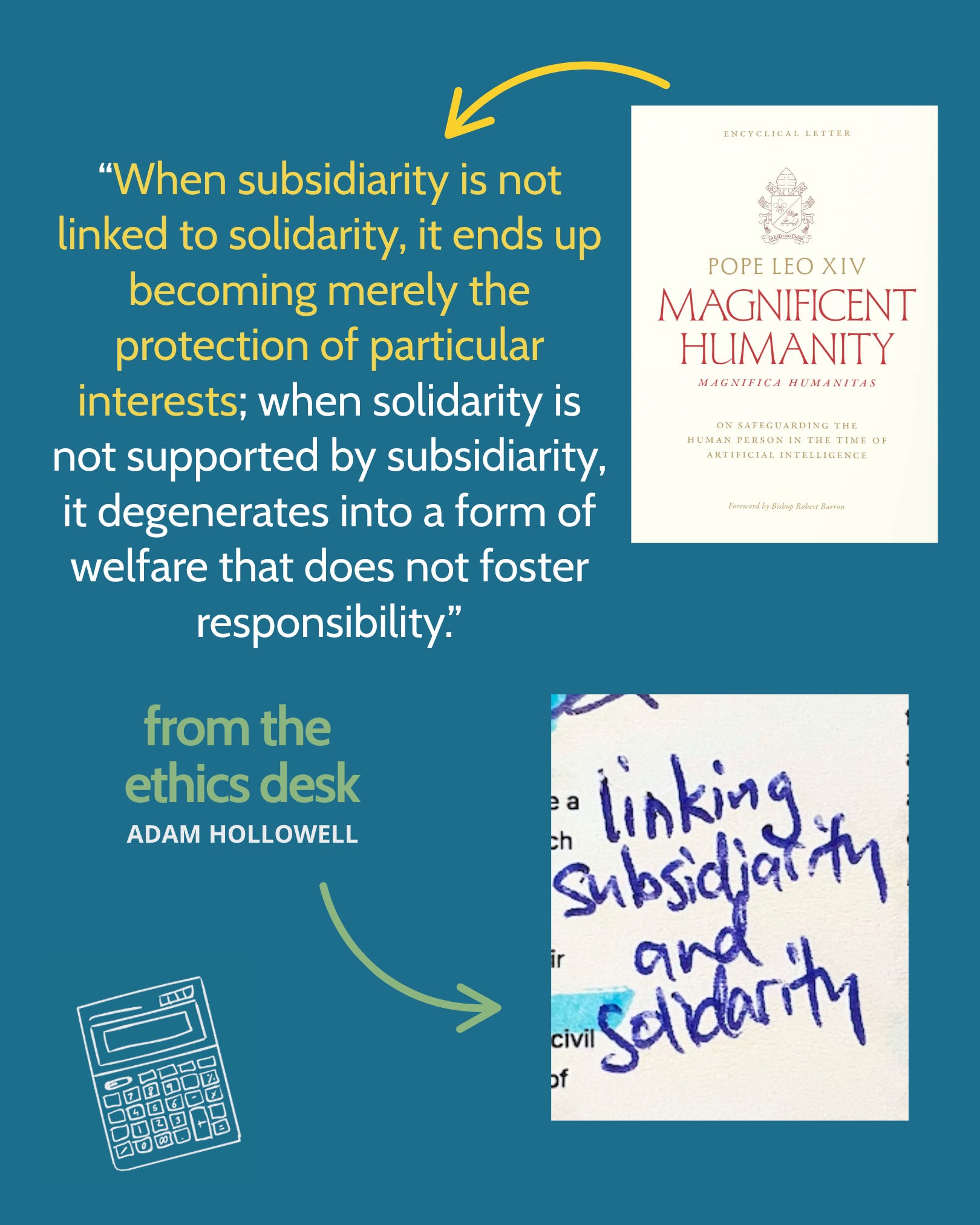
“When subsidiarity is not linked to solidarity, it ends up becoming merely the protection of particular interests; when solidarity is not supported by subsidiarity, it degenerates into a form of welfare that does not foster responsibility.” — Pope Leo XIV, Magnifica Humanitas
Subsidiarity is the Catholic principle that decisions belong as close as possible to the people whose lives they affect, with higher authorities existing to support local communities rather than supplant them. In Magnifica Humanitas Leo XIV aims subsidiarity squarely at the AI companies now amassing power over everything and everyone. Chris Olah, an executive at the AI company Anthropic, delivered a response to the encyclical at the Vatican on the day it was released.
I offered my commentary over at Adam Hollowell on AI Ethics.
5. Justice in resistance, not false realism
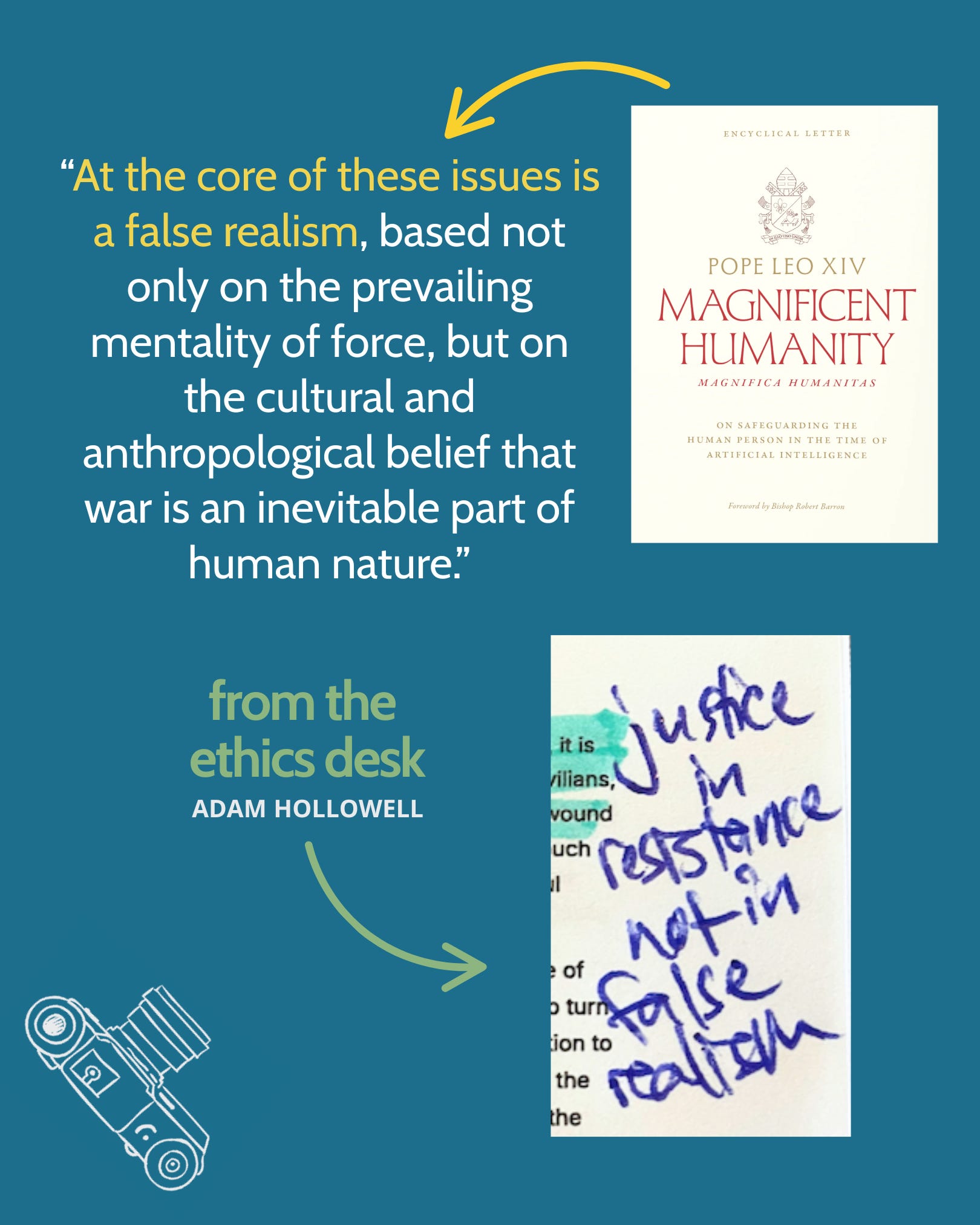
“At the core of these issues is a false realism, based not only on the prevailing mentality of force, but on the cultural and anthropological belief that war is an inevitable part of human nature.” — Pope Leo XIV, Magnifica Humanitas
Twenty years ago I was just starting a PhD in theological ethics with a focus on Christian theories of just war theory and pacifism. When I asked a friend from those years if he’d read the encyclical, he replied, “No, I just dropped in for the slam on just war theory.” Here’s what he meant: Leo XIV withholds the word just during a long stretch on war in chapter five. Instead he offers a full-throated condemnation of the modern culture of force without limits, the use of artificial intelligence to make war convenient and depersonalized, and “the possibility that some leaders may consider armed conflict as an effective way of diverting attention from domestic problems.” He condemns the unjust neutrality of the passive (not pacifist) witness, too:
“There are times when, in order to remain human, we must set aside our reservations and take a stand. In come conflicts, it is unjust to remain neutral, nor is it enough merely to claim that we are not complicit. When we witness the bombing of civilians, attacks on hospitals, schools or vital infrastructure, and violence that affects children, we are confronted with scandals that wound humanity itself.” — Pope Leo XIV, Magnifica Humanitas
6. PREACH!
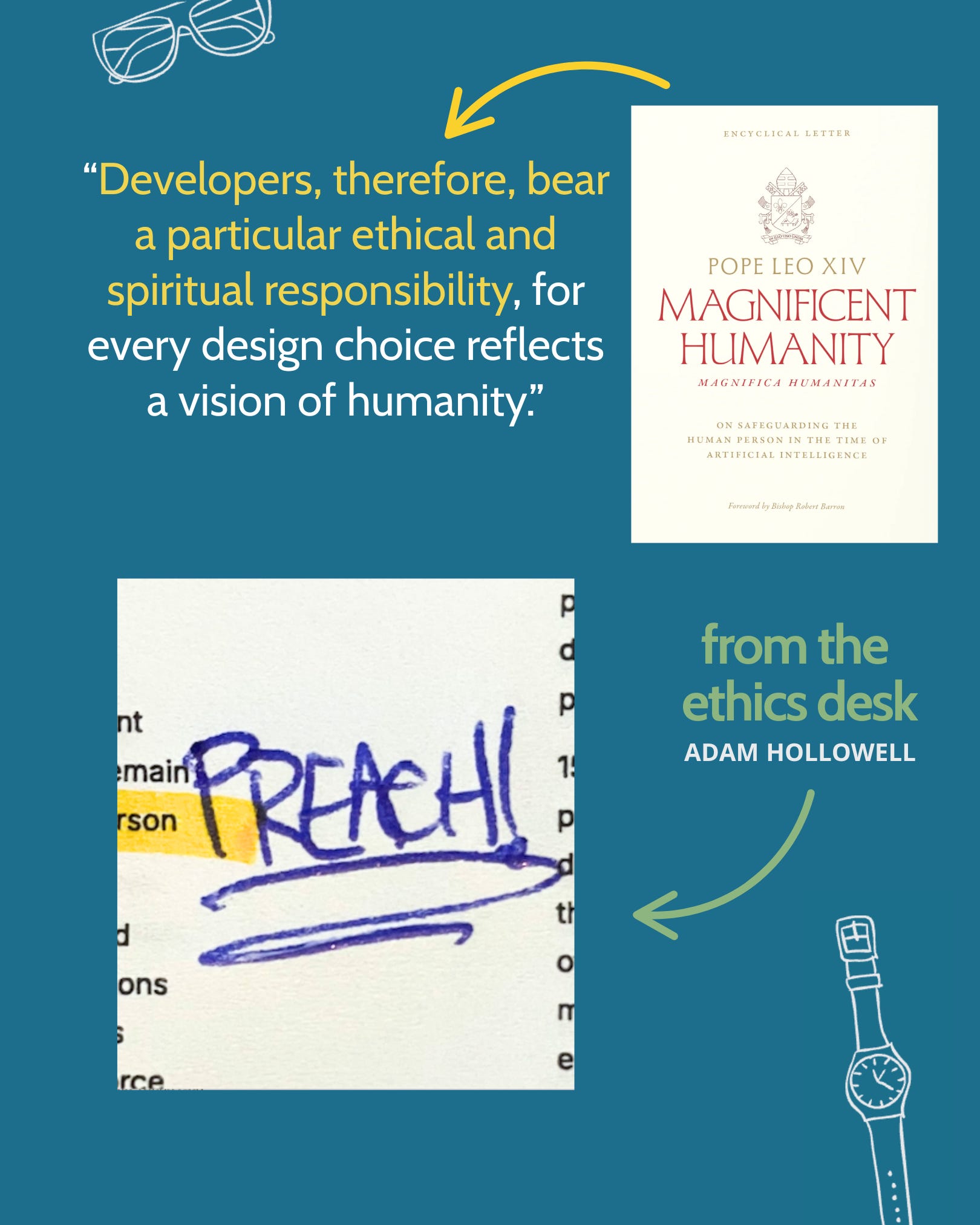
“I wish to address a special appeal to those who develop artificial intelligence. … Developers, therefore, bear a particular ethical and spiritual responsibility, for every design choice reflects a vision of humanity. Just as the creator of an artistic or literary work must consider the values it conveys, so developers are called to embed values in their projects with due seriousness: with transparency, responsibility toward affected communities and careful attention to ensuring that what is being cultivated is a genuine good.” — Pope Leo XIV, Magnifica Humanitas
As an ethicist who’s working toward possibilities of ethical and responsible AI, it was tremendously heartening to hear such an important figure address the the people who build AI systems so clearly and directly. And with a message that we need design choices in technology that reflect a genuinely good, sustainable, and collective vision for humanity. Again, PREACH!